What Is Very Poor Beef Has Been Drawn Mean
Past Brian Deese, Sameera Fazili, and India Ramamurti
The President understands that families take been facing college prices at the grocery store recently. One-half of those recent increases are from meat prices—specifically, beef, pork, and poultry. While factors like increased consumer need take played a function, the price increases are also driven by a lack of competition at a cardinal bottleneck point in the meat supply concatenation: meat-processing. But four large conglomerates control the majority of the market for each of these three products, and the data show that these companies have been raising prices while generating record profits during the pandemic. That'southward why the Biden-Harris Administration is taking bold action to enforce the antitrust laws, heave contest in meat-processing, and push back on pandemic profiteering that is hurting consumers, farmers, and ranchers beyond the state.
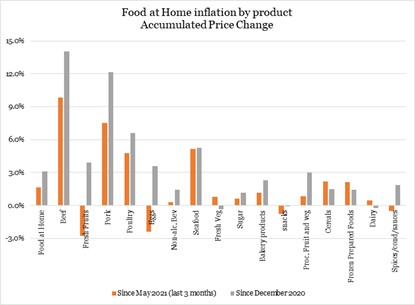
Meat constitutes half of food at home price increases. Big toll increases for beef, pork, and poultry are driving the recent price increases consumers are seeing at the grocery store (a measure commonly known as "food at home"). Together, these iii items account for a full one-half of the price increase for food at habitation since December 2020. Since that time, prices for beefiness accept risen by 14.0%, pork by 12.i%, and poultry by 6.vi%.
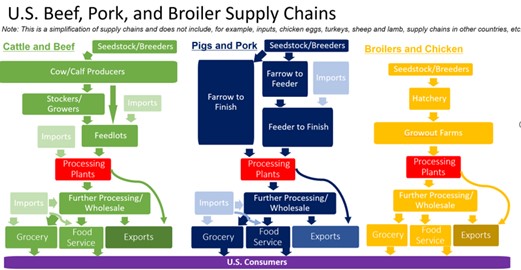
Four big conglomerates overwhelmingly control meat supply chains, driving down earnings for farmers while driving upwardly prices for consumers. The meatpacking manufacture buys cattle, hogs, and chickens from farmers and ranchers, processes it, and and so sells beefiness, pork, and poultry on to retailers like grocery stores. The industry is highly consolidated, and serves equally a key asphyxiate bespeak in the supply chain (meet figure beneath).
Today, merely four firms control approximately 55-85% of the market for these three products, according to U.S. Department of Agriculture data. That reflects dramatic consolidation of the industry over the last 5 decades, as the large conglomerates have absorbed more and more than smaller processors. In 1977, the largest four beef-packing firms controlled simply 25% of the market, compared to 82% today. In poultry, the acme 4 processing firms controlled 35% of the market in 1986, compared to 54% today. And in pork, the top four hog-processing firms controlled 33% of the market in 1976, compared to 66% today.
That consolidation gives these middlemen the power to clasp both consumers and farmers and ranchers. At that place's a long history of these giant meat processors making more than and more, while families pay more at the grocery store and farmers and ranchers earn less for their products. Absent this corporate consolidation, prices would exist lower for consumers and fairer for farmers and ranchers.
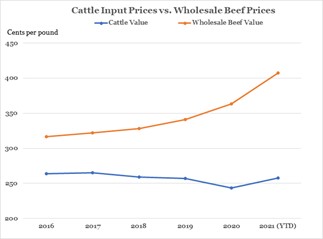
The meat-processors are generating record profits during the pandemic, at the expense of consumers, farmers, and ranchers. The dynamic of a hyper-consolidated pinch point in the supply chain raises real questions about pandemic profiteering. During the pandemic, wholesale prices for beef rose much faster than input prices for cattle. That ways that the prices the processors pay to ranchers aren't increasing, but the prices collected by processors from retailers are going up.
At the same time, nosotros have seen some of the acme firms in this manufacture generate record gross profits and their highest gross margins in years. Gross profits for some of the leading beef, poultry, and pork processors are at their highest levels in history, and Q1 2021 and Q2 2021 were the nigh assisting quarters in history for some of these processors. Internet income for many of these companies is on stride to reach historic highs too. (Other tiptop processors simply don't report publicly on their profits, margins, or income.)
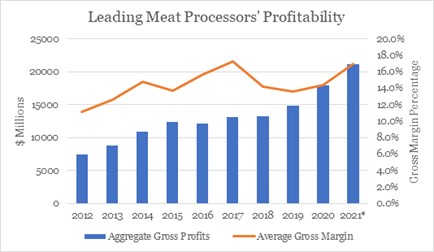
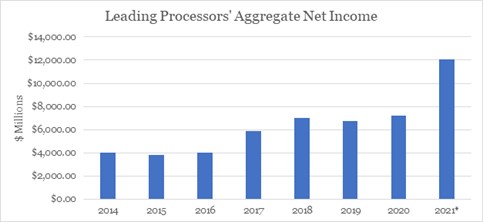
*2021 numbers are projected using the quarterly numbers reported this year.
These tape profits, income, and margins underscore the role that meat-processors' dominant market position and power play in increasing meat prices. While factors like consumer demand and input costs are affecting the market, it is the lack of competition that enables meat processors to hike prices for meat while increasing their own profitability. That is, if they faced meaningful competition, the processors would simply be able to excerpt fewer profits if their costs had gone up unexpectedly while keeping prices lower to earn retailers' business organization.
Some of these companies have as well been rewarding their shareholders with big dividends and buybacks during this menses. For case, the large processor JBS provided $two.3 billion in dividends and share buybacks in 2020. Information technology has proposed record high dividend payments for 2021, increasing payouts to shareholders past well-nigh 75% over 2020. Similarly, Tyson recently raised dividends by 6% for financial year 2021, spending $477 million on dividends in the ix months ending July 2021. It also repurchased $200 one thousand thousand of shares between September 2020 and July 2021.
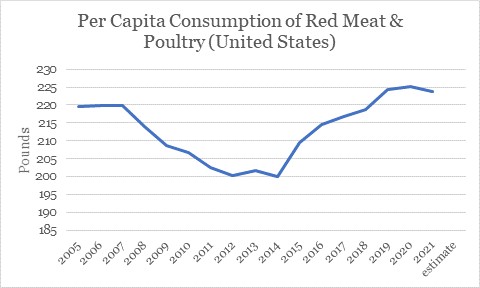
These record profits and dividend payments come at a time when consumers are paying more to put nutrient on the table, workers are risking their health and safety to keep America fed, and farmers and ranchers are likewise facing unprecedented droughts, wildfires, and other extreme conditions events that put their herds and farms at risk. Meanwhile, taxpayers take made historic investments to assistance businesses keep their doors open up and families cope with the economic impacts of this pandemic. These taxpayer investments take kept per capita demand for meat steady, unlike the collapse in demand the meat industry experienced in the Great Recession.
Equally we restart the earth's largest economic system and make groovy strides in the economic recovery, the Biden-Harris Assistants is committed to restarting right for the American people—consumers and producers alike—by transforming the nutrient system. This is a pivotal moment of opportunity to build back a meliorate food system that is fair, competitive, distributed, and resilient.
The Biden-Harris Assistants and USDA are taking on these issues by:
- Taking stiff actions to crack down on illegal toll fixing, enforce antitrust laws, and bring more transparency to the meat-processing industry. USDA is conducting an ongoing articulation investigation with the Department of Justice into price-fixing in the chicken-processing manufacture, which has already yielded a $107 million guilty plea by Pilgrim'southward Pride and numerous other indictments. USDA has also announced a more robust Packers and Stockyards Deed enforcement policy and new efforts to strengthen Packers and Stockyards Human action rules, and then that meat-processors tin't use their market dominance to abuse farmers and ranchers. And USDA is creating more transparency, with new market reports on what beefiness-processors pay, besides as new rules designed to ensure consumers get what they pay for when meat is labeled "Production of U.s.."
- Providing relief to modest businesses and workers hurt by COVID, and creating a more competitive food supply chain. USDA will invest $i.four billion in pandemic assistance to provide relief to small producers, processors, distributors, farmers markets, seafood processors, and food and subcontract workers impacted by COVID-19. This includes $700 million to achieve pocket-size operations who have not received previous rounds of federal pandemic aid. USDA will as well provide $700 meg to states, tribes, and nonprofit organizations to distribute up to $600 per worker in relief payments directly to frontline farmworkers and meatpacking workers who incurred expenses preparing for, preventing exposure to, and responding to the COVID-19 pandemic. USDA will also invest $500 million in American Rescue Programme Act funds to support new competitive entrants to expand local and regional meat and poultry processing capacity. USDA will provide grants, loans, and technical assist to create new meat and poultry processing capacity that volition compete with the large guys, forcing them to lower prices and actually earn their business, and provide farmers and ranchers access to amend choices and fairer prices in local and regional food systems.
- Getting ahead of climate change related disruptions past supporting farmers and ranchers from the effects of farthermost atmospheric condition. Unprecedented drought and extreme weather events have brought new challenges for farmers, ranchers, and agricultural workers, on top of the historic challenges associated with the COVID-19 pandemic. To respond to the drought affecting farmers and ranchers across the West and Midwest, USDA will expand its Emergency Aid for Livestock, Honeybees and Farm-Raised Fish Programme (ELAP) to include the cost of transporting feed, delivering much-needed relief to affected livestock producers.
- Working with Congress to brand cattle markets more transparent and fairer. Right now, meatpackers have outsized power in setting the prices for beef, which are oftentimes set in opaque contracts that lock independent livestock producers into prices that aren't the product of free and off-white negotiation. The Administration is encouraged to see bipartisan legislation past Senators Tester, Fischer, Grassley, Wyden, and others that seek to improve price discovery in the cattle markets—and facilitate actual negotiation of prices between livestock producers and packers. We look forward to working with Congress on these of import problems, and we promise that they volition also expect for ways to ensure farmers and ranchers have fair access to meat-processing capacity.
All together, these actions will help build a food system that works for the American people above all else. They will support families, farmers, and workers while preventing bad actors in the supply chain from lining their pockets and getting farther ahead without accountability. This will make the food organisation fairer and more than equitable, more competitive and transparent, and more distributed and resilient against shocks. In turn, it volition increase farmers' and ranchers' earnings, deliver greater value to workers, and offer consumers affordable, good for you food produced closer to dwelling house.
Source: https://www.whitehouse.gov/briefing-room/blog/2021/09/08/addressing-concentration-in-the-meat-processing-industry-to-lower-food-prices-for-american-families/
0 Response to "What Is Very Poor Beef Has Been Drawn Mean"
Post a Comment