What Is the Circle Gguid Line in Art Called
| square circumvolve grid | |||||
|---|---|---|---|---|---|
| i+ |  |  |  |  |  |
| iv |  |  |  |  |  |
| 9 |  |  |  |  |  |
| Centered square lattice forms | |||||
| 5 |  |  |  |  |  |
| thirteen |  |  |  |  |  |
 |  |  |  |  | |
| triangular circle grid | |||||
| 1+ |  |  |  |  |  |
| iii |  |  |  |  |  |
| four |  |  |  |  |  |
| 7 |  |  |  |  |  |
| 19 |  |  |  |  |  |
 |  |  |  |  | |
An overlapping circles filigree is a geometric pattern of repeating, overlapping circles of an equal radius in two-dimensional space. Commonly, designs are based on circles centered on triangles (with the uncomplicated, two circle form named vesica piscis) or on the square lattice pattern of points.
Patterns of seven overlapping circles appear in historical artefacts from the 7th century BC onwards; they become a oft used ornamentation in the Roman Empire period, and survive into medieval artistic traditions both in Islamic art (girih decorations) and in Gothic fine art. The name "Blossom of Life" is given to the overlapping circles pattern in New Age publications.
Of special interest is the half-dozen petal rosette derived from the "seven overlapping circles" blueprint, also known as "Sun of the Alps" from its frequent utilize in tall folk art in the 17th and 18th century.
Triangular grid of overlapping circles [edit]
 |
| This pattern can exist extended indefinitely, seen here with hexagonal rings of i, 7, 19, 37, 61, 91 circles... |
The triangular lattice form, with circle radii equal to their separation is called a seven overlapping circles filigree.[1] It contains 6 circles intersecting at a point, with a seventh circle centered on that intersection.
Overlapping circles with similar geometrical constructions have been used infrequently in various of the decorative arts since ancient times. The blueprint has establish a wide range of usage in popular civilization, in mode, jewelry, tattoos and decorative products.
Cultural significance [edit]
Almost East [edit]
The oldest known occurrence of the "overlapping circles" pattern is dated to the 7th or 6th century BCE, found on the threshold of the palace of Assyrian rex Aššur-bāni-apli in Dur Šarrukin (now in the Louvre).[ii]
The design becomes more than widespread in the early centuries of the Common Era. One early on example are five patterns of xix overlapping circles fatigued on the granite columns at the Temple of Osiris in Abydos, Egypt,[3] and a further v on column contrary the edifice. They are drawn in crimson ochre and some are very faint and hard to distinguish.[4] The patterns are graffiti, and non constitute in natively Egyptian ornaments. They are more often than not dated to the early on centuries of the Christian Era[v] although medieval or even modern (early 20th century) origin cannot be ruled out with certainty, as the drawings are not mentioned in the all-encompassing listings of graffiti at the temple compiled past Margaret Murray in 1904.[vi]
Similar patterns were sometimes used in England every bit apotropaic marks to keep witches from entering buildings.[7] Induction crosses indicating points in churches anointed with holy water during a churches dedication also take the grade of overlapping circles.

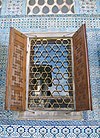
In Islamic art, the pattern is one of several arrangements of circles (others being used for fourfold or fivefold designs) used to construct grids for Islamic geometric patterns. It is used to design patterns with half dozen- and 12-pointed stars also as hexagons in the style called girih. The resulting patterns however characteristically conceal the construction filigree, presenting instead a design of interlaced strapwork.[8]
Europe [edit]
Patterns of 7 overlapping circles are establish on a Cypro-Archaic I cup of the 8th-7th century BC in Cyprus[ citation needed ] and Roman mosaics, for example at Herod's palace in the 1st century BC.
The blueprint is found on one of the silver plaques of the Late Roman hoard of Kaiseraugst (discovered 1961).[9] It is afterward found equally an ornament in Gothic compages, and still afterwards in European folk art of the early modernistic period.
High medieval examples include the Cosmati pavements in Westminster Abbey (13th century).[10] Leonardo da Vinci explicitly discussed the mathematical proportions of the design.[11]
Modern usage [edit]

19-circle with arcs
Pendant, silver, ⌀ 27 mm
(commercial production, 2013)
The name "Flower of Life" is mod, associated with the New Age move, and unremarkably attributed specifically to Drunvalo Melchizedek in his book The Ancient Undercover of the Bloom of Life (1999).[12] [13]
The blueprint and modern proper name have propagated into wide range of usage in popular culture, in fashion, jewelry, tattoos and decorative products. The pattern in quilting has been called diamond nuptials ring or triangle wedding ring to contrast it from the foursquare pattern. Besides an occasional use in manner,[14] it is too used in the decorative arts. For example, the album Sempiternal (2013) by Bring Me the Horizon uses the 61 overlapping circles grid as the main feature of its album cover,[fifteen] whereas the anthology A Head Full of Dreams (2015) by Coldplay features the 19 overlapping circles grid as the primal part of its album embrace. Teaser posters illustrating the cover art to A Head Full of Dreams were widely displayed on the London Underground in the last week of Oct 2015.[16]
The "Sun of the Alps" (Italian Sole delle Alpi) symbol has been used every bit the emblem of Padanian nationalism in northern Italy since the 1990s.[17] Information technology resembles a pattern often found in that surface area on buildings.[18]
Gallery [edit]
- 1, 7, and 19-circumvolve hexagonal variant
In the examples below the pattern has a hexagonal outline, and is further circumscribed.
-

1-circle with completed arcs
-

7-circumvolve: Mosaic floor from a bathhouse in Herod'south palace, 1st century BCE
-

19-circle symbol with completed arcs and bounded by a larger circle
-

19-circle: Two symbols drawn in red ochre Temple of Osiris at Abydos, Egypt
-
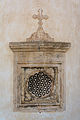
19-circle: A window at the southern apsis of the church building of Preveli Monastery (Moni Preveli), Crete.
- Like patterns
In the examples below the pattern does not take a hexagonal outline.
-

-

Cup with mythological scenes, a sphinx frieze and the representation of a king vanquishing his enemies. Cypro-Primitive I (8th–7th centuries BC). From Idalion, Cyprus.
-

Floor decoration from the northern Iraq palace of King Ashurbanipal, visible in the Museum of Louvre, dated 645BC.
-

"Dominicus of the Alps" emblem used by the Lega Nord
Structure [edit]
Martha Bartfeld, author of geometric art tutorial books, described her independent discovery of the design in 1968. Her original definition said, "This design consists of circles having a 1-[inch; 25 mm] radius, with each point of intersection serving as a new center. The design can be expanded advertizement infinitum depending upon the number of times the odd-numbered points are marked off."
The blueprint effigy can exist drawn by pen and compass, by creating multiple serial of interlinking circles of the same diameter touching the previous circle's middle. The second circle is centered at whatsoever point on the first circle. All post-obit circles are centered on the intersection of two other circles.

Progressions [edit]
The pattern can be extended outwards in concentric hexagonal rings of circles, as shown. The first row shows rings of circles. The 2d row shows a three-dimensional interpretation of a ready of northward×due north×due north cube of spheres viewed from a diagonal axis. The third row shows the blueprint completed with partial circumvolve arcs within a set of completed circles.
Expanding sets have one, 7, 19, 37, 61, 91, 127, etc. circles, and continuing ever larger hexagonal rings of circles. The number of circles is north 3-(n-1)iii = 3n ii-3n+1 = iiin(n-1)+i.
These overlapping circles can also be seen equally a projection of an n-unit cube of spheres in 3-dimensional infinite, viewed on the diagonal centrality. There are more spheres than circles because some are overlapping in two dimensions.
| 1-circle | 7-circumvolve (8-1) | 19-circle (27-eight) | 37-circle (64-27) | 61-circumvolve (125-64) | 91-circle (216-125) | 127-circumvolve... (343-216) |
|---|---|---|---|---|---|---|
 |  |  |  |  |  |  |
| i-sphere (1×1×1) | viii-sphere (2×ii×2) | 27-sphere (3×three×three) | 64-sphere (four×iv×four) | 125-sphere (5×5×v) | 216-sphere (half-dozen×6×6) | 343-sphere (seven×7×7) |
 |  |  | ||||
| +12 arcs | +24 arcs | +36 arcs | +48 arcs | +60 arcs | +72 arcs | +84 arcs |
 |  |  |  |  |  |
Other variations [edit]
Another triangular lattice grade is common, with circle separation as the square root of three times their radius. Richard Kershner showed in 1939 that no arrangement of circles can cover the plane more efficiently than this hexagonal lattice arrangement.[nineteen]
2 offset copies of this circle design makes a rhombic tiling pattern, while three copies brand the original triangular pattern.
-

19 circle example
-

Two get-go copies of the minimal covering circle pattern (left) make a rhombic tiling blueprint, like this red, blue version.
-

Three commencement copies of the minimal covering circle blueprint (left almost image) make the 7-circle pattern, like this red, green, blue version.
[edit]
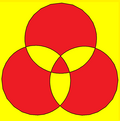
The center lens of the 2-circle effigy is called a vesica piscis, from Euclid. Two circles are also called Villarceau circles as a plane intersection of a torus. The areas within one circle and outside the other circumvolve is called a lune.
The 3-circumvolve effigy resembles a depiction of borromean rings and is used in three-set theory Venn diagrams. Its interior makes a unicursal path called a triquetra. The center of the 3-circle figure is called a reuleaux triangle.
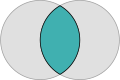 Vesica piscis |  Borromean rings |  Venn diagram |  Triquetra | 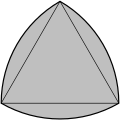 Reuleaux triangle |
Some spherical polyhedra with edges along great circles can be stereographically projected onto the plane as overlapping circles.
 octahedron |  Cuboctahedron | 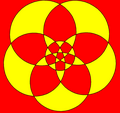 Icosidodecahedron |
The 7-circle pattern has also been called an Islamic 7-circles pattern for its employ in Islamic art.
Square grid of overlapping circles [edit]
| ||
|



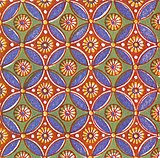
The square lattice form can exist seen with circles that line upwards horizontally and vertically, while intersecting on their diagonals. The pattern appears slightly different when rotated on its diagonal, also called a centered square lattice grade because it can exist seen as ii square lattices with each centered on the gaps of the other.
Information technology is called a Kawung motif in Indonesian batik, and is found on the walls of the 8th century Hindu temple Prambanan in Coffee.
It is called an Apsamikkum from ancient Mesopotamian mathematics.[20]
-
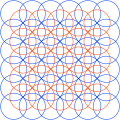
The related five overlapping circles grid is constructed by from ii sets of overlapping circles half-offset.[21]
-
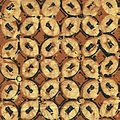
Kawung or "Java Bean" Batik sarong (detail), Coffee, Indonesia
See also [edit]
- Uniform tiling symmetry mutations - pattern mutations in 3D space
- Knot theory
References [edit]
- ^ Islamic Art and Geometric Pattern: Activities for Learning
- ^ Louvre Inv.-Nr. AO 19915. Georges Perrot, Charles Chipiez, A History of Art in Chaldæa and Assyria, vol. 1, London 1884, S. 240, (gutenberg.org)
- ^ Weisstein, Eric Due west. "Flower of life". MathWorld.
- ^ Stewart, Malcolm (2008). "The "Bloom of Life" and the Osirion – Facts are more interesting than Fantasy". Egyptian Tour (David Furlong) . Retrieved November 8, 2015.
- ^ Furlong, David. "The Osirion and the Bloom of Life". Retrieved November 8, 2015. Furlong states that these engravings can engagement no earlier than 535 BCE and probably engagement to the 2nd and 4th century CE. His research is based on photographic testify of Greek text, yet to be fully deciphered. The text is seen alongside the designs and the position close to the top of columns, which are greater than 4 meters in peak. Furlong suggests the Osirion was one-half filled with sand prior to the circles being drawn and therefore likely to have been well afterwards the end of the Ptolemaic dynasty.
- ^ Murray, Margaret Alice (1904). The Osireion at Abydos London. p. 35. Retrieved November four, 2015.
- ^ Kennedy, Maev (October 31, 2016). "Witches' marks: public asked to seek ancient scratchings in buildings". The Guardian. Retrieved October 31, 2016.
- ^ Broug, Eric (2008). Islamic Geometric Patterns. Thames and Hudson. pp. 22–23 and passim. ISBN978-0-500-28721-7.
- ^ Hans Ulrich Instinsky: Der spätrömische Silberschatzfund von Kaiseraugst. Mainz 1971, plaque 85.
- ^ The Cosmati Pavements in Westminster Abbey. Abgerufen am 14. September 2013.
- ^ Codex Atlanticus, foll. 307r–309v, 459r (dated between 1478 and 1519).
- ^ Bartfeld, Martha (2005). How to Create Sacred Geometry Mandalas. Santa Atomic number 26, NM: Mandalart Creations. p. 35. ISBN9780966228526. OCLC 70293628.
- ^ Weisstein, Eric Due west. (2002). CRC Concise Encyclopedia of Mathematics, Second Edition. CRC Printing. p. 1079. ISBN1420035223.
- ^ E.g. Zaman, Sana (May 14, 2013). "Zaeem Jamal Launches New Drove on Board a Individual Yacht in Dubai Marina". Haute Living. Retrieved November 9, 2015.
- ^ Cooper, Ed (February 25, 2013). "Bring Me The Horizon: This anthology needs to exist the one that lasts forever". The Independent. Archived from the original on October 23, 2015. Retrieved Nov viii, 2015.
- ^ Denham, Jess (November 6, 2015). "Coldplay new album: Beyonce and Noel Gallagher to feature on A Head Full of Dreams". The Independent. Retrieved November 8, 2015.
- ^ "Il significato del simbolo del Sole delle Alpi" (in Italian). Lega Nord. Archived from the original on January 12, 2014. Retrieved December 1, 2014.
- ^ Ivano Dorboló (June 6, 2010). "The church building of South.Egidio and the Sun of the Alps symbol". Storia di Confine – Valli di Natisone . Retrieved November ix, 2015.
- ^ Sphere Packings, Lattices and Groups, John Conway, Neil J. A. Sloane, Chapter ii, department i.1, Roofing infinite with overlapping circumvolve. pp. 31-32. Figure 2.ane Roofing the plane with circles (b) The more efficient or thinner roofing in a hexagonal lattice. [1]
- ^ Mesopotamian Mathematics 2100-1600 BC: Technical Constants in Bureaucracy and Instruction (Oxford Editions of Cuneiform Texts), Eleanor Robson, Clarendon Press, 1999, ISBN 978-0198152460 [2] at books.google.com
- ^ Creating Square Grids from Circles
External links [edit]
- Weisstein, Eric W. "Circle-circle intersection". MathWorld.
- The flower of life commodity from The Mystica
Source: https://en.wikipedia.org/wiki/Overlapping_circles_grid
0 Response to "What Is the Circle Gguid Line in Art Called"
Post a Comment