Will Pluto Be a Plante Again
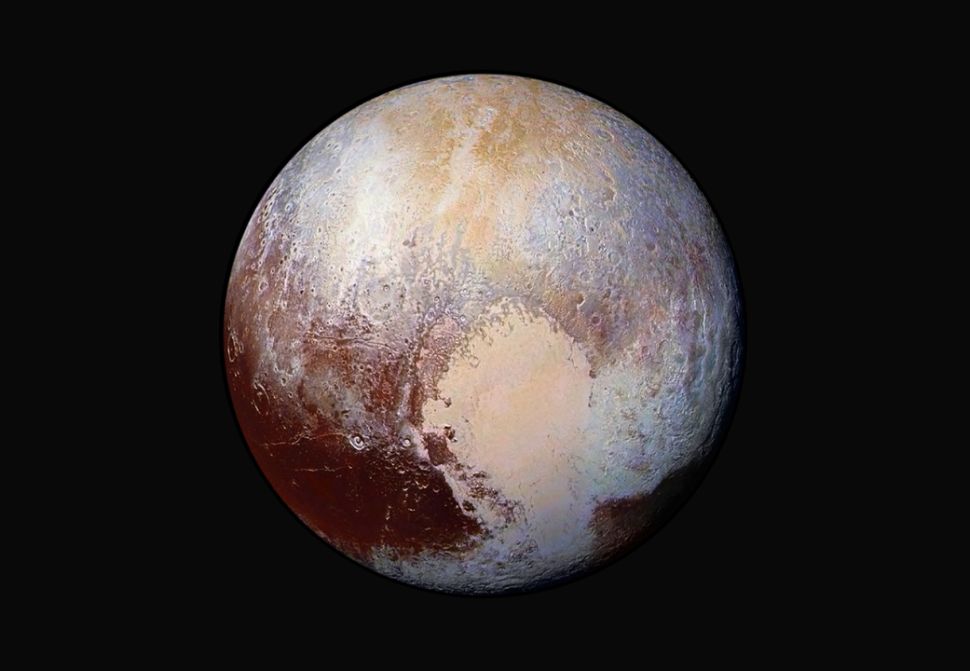
In 2006, Pluto was relegated from being the ninth planet in the solar organisation after the International Astronomical Union (IAU) demoted it to a "dwarf planet". Officially, Pluto is at present known as "minor planet 134340 Pluto."
Many astronomy buffs were disappointed past the new assignment, seeing the criteria for Pluto's demotion as rather nitpicky or fifty-fifty capricious.
But don't scratch Pluto off equally a planet only notwithstanding. At that place are nevertheless many administrative voices in scientific discipline who fence that the frozen world on the outer rim of the solar organisation should truly be classed as a planet in its ain correct.
Why was Pluto demoted in the outset place?
The existence of Pluto was starting time proposed in the early on 20th-century by Percival Lowell, whose calculations showed that wobbles in the orbits of Uranus and Neptune must be caused by the gravitational pull of an unknown ninth planet. Pluto was confirmed a decade after, on March 13, 1930, at the Lowell Observatory in Flagstaff, Arizona, past astronomer Clyde Due west. Tombaugh.
Since then Pluto's status as the solar system's 9th planet remained unchallenged until astronomers discovered 2003 UB313, likewise known as Eris, which is well-nigh as big equally Pluto, but with a lot more mass.
The discovery of Eris triggered a fiery argue amidst astronomers. If Pluto is a planet, then so should Eris. Eventually, both were classed as dwarf planets after the IAU issued new criteria for what constitutes a planet. Essentially, IAU says that a planet must:
- Orbit around the sun;
- Have sufficient mass to presume hydrostatic equilibrium (gets squished into a sphere-like object due to gravity);
- clears the neighborhood around its orbit.
In Baronial 2006, the IAU ruled that Pluto would no longer be considered a planet because it doesn't "clear the neighborhood effectually its orbit." Pluto's ellipsoidal orbit overlaps that of Neptune, so it was disqualified.
Instead, the IAU classed Pluto as a dwarf planet, which is a celestial trunk that meets the first ii criteria. Besides Pluto and Eris, there are three other known dwarf planets in the solar system: Ceres in the asteroid chugalug between Mars and Jupiter; Haumea, which is located beyond Neptune's orbit, and Makemake, the 2d-largest Kuiper Belt object.
Why should Pluto be considered a planet over again?
Bearing this in mind, information technology's clear that had the IAU not stuck to its new rules, we would have had at to the lowest degree xiii planets in the solar system now. But why should that be a problem?
Many accept criticized IAU's definition of a planet, challenge the criteria are arbitrary. Among these critics is NASA administrator Jim Bridenstine, who during a keynote at the 2019 International Astronautical Congress said:
"I am here to tell you, as the NASA administrator, I believe Pluto is a planet," before calculation that "Some people have argued that in order to exist a planet you have to articulate your orbit effectually the sun. If that's the definition we're going to employ then yous could undercut all the planets—they're all dwarf planets—considering at that place isn't a planet that clears its entire orbit around the dominicus."
The NASA chief is referring to asteroids, which regularly whizz past all the planets in the solar system.
"I call back it'southward a sloppy definition," said Bridenstine. "I call back the fashion you should define a planet is based on its intrinsic value, not values that constantly alter like orbital dynamics."
Naming planets: a bureaucratic decision?
Bridenstine's opinion on Pluto is supported by the authors of a study published in a 2019 edition of the periodical Icarus past a squad of researchers led by Philip Metzger, a planetary physicist with the Planetary Scientific discipline faculty at the University of Central Florida. Although the paper doesn't focus on Pluto specifically, the authors explain how fifty-fifty asteroids were recognized as planets until the 1950s.
"In the 1950s, developments in planet formation theory found it no longer useful to maintain taxonomic identification betwixt asteroids and planets, Ceres being the main exception. At approximately the same time, there was a flood of publications on the geophysical nature of asteroids showing them to be geophysically different than the large planets. This is when the terminology in asteroid publications calling themplanets abruptly plunged from a high level of usage where information technology had hovered during the catamenia 1801–1957 to a low level that held constant thereafter," the scientists wrote.
In effect, asteroids were reclassified as not-planets based on their geophysical characteristics. Past extension, all cosmic bodies should also exist classified by their geophysical characteristics and not arbitrarily through voting by a panel.
"I believe the IAU made several deep mistakes and and then the definition is not valid and non scientifically useful and should be rejected. Starting time, definitions should never be voted on for taxonomical concepts like "planet" because taxonomy is supposed to evolve and develop as an integral office of the science. By voting on a particular taxonomical selection they shut down that portion of the scientific procedure. So the entire vote was anti-science to begin with," Metzger told ZME Science.
Metzger adds that the IAU actually violated their principles, "including their explicit statutes and bylaws, which require the actual language of a proposed vote to be reviewed past all the members for 4 months before the assembly."
Since the IAU was in a bustle to force a decision, the system violated its by-laws by not sharing the proposal text until the 2006 assembly.
"That was the starting time violation, the kickoff mistake. Then the proposal was rejected at the convention, and since they had already gear up the precedent of breaking the rules they connected blindly breaking the rules even more. So they made upward the definition during the assembly, giving nobody anywhere else in the globe any time to assimilate it, giving nobody the option to come up to the meeting to nowadays a well reasoned and well-researched case to sway the outcome, and they forced a vote. They got a deep separate in the votes, proving there really is no consensus, but one side won so they alleged that the deed was washed. That became highly politicized and caused people to accept sides and get emotionally involved, and so now well-nigh people have an attitude well-nigh the whole thing and it has poisoned the ability to readdress the question," Metzger said.
Perhaps you've noticed a pattern: the master objection that Pluto planetary advocates accept against the IAU conclusion is that information technology didn't follow a scientific process. Instead, it was based on a subjective, bureocratic process.
"Nobody is creating a theory about how objects that fail to clear their orbits are fundamentally different than those that practise articulate their orbits or those that are satellites of some other planet. Nobody has always proposed differences in geology, geochemistry, atmospheres, oceans, the emergence of life, mineralogy, etc., that are consistent 1 manner in bodies that articulate their orbits versus some other way in bodies that do not clear their orbits. On the other paw, the term "planet" actually is being used to compare dissimilar planets across different dynamical states. Then a paper might hash out Pluto, Triton, and Mars, calling them all "planets", fifty-fifty though i cleared an orbit, one did not, and one was captured by Neptune to become a satellite," Metzger said.
"Summary: the IAU definition does not match how scientists actually apply the planet concept in doing real, reductionist science. The definition they created was actually designed to keep the number of planets small and then school kids could memorize the planets, but having a small number is not the concern of scientific discipline. The IAU abandoned scientific discipline in club to create a cultural definition instead," he added.
Wait, does that hateful that the Moon and other satellites are planets besides? Exactly.
"The idea that satellites are a distinct category with no overlap in the "planet" category is actually a recent invention. For almost all scientific history, moons were planets. What scientists used to say before the 1920s is that planets orbiting the sun are "chief planets" while planets that orbit another planet are "secondary planets" or only "satellite" or "moon" for short (simply they were still known to exist planets). Existence a satellite was just a dynamic relationship that a planet could take with another planet. When we decided that most asteroids are too pocket-size to be planets, in the 1960s, so we should have decided at the same time that the smaller satellites are as well as well small to be planets for the exact same reason, while the larger, round satellites are even so planets. Unfortunately, astronomers had already go confused most satellites past the 1920s and forgot the pregnant of the word "planet", switching over to a cultural "folk taxonomy" that actually has its roots in astrology and geocentrism. The public was abandoning geocentrism in the late 1700s and early 1800s, and astrology was still very influential, and this led them to develop the idea that satellites are not planets. I am currently writing a manuscript that shows this. Information technology was like to the general public's idea that green beans are a vegetable rather than a fruit, although biologists say a light-green bean is a fruit. The public develops a "folk taxonomy" that is human-centric and non scientifically reductionist, in dissimilarity to the scientific taxonomy that is designed to align along the natural divisions of reductionist theory, thus providing deep explanatory power about nature," Metzger said.
"So although the public is even so unaware of this fact, it is true that planetary scientists are referring to moons as "planet". Many of us practise non even realize nosotros are doing this. We say Titan has a planetary core, a planetary chaff, a planetary radius, etc. They are "planetary" because they are characteristic of planets. Being a satellite has nothing to exercise with it. But if having these things are characteristic of planets, and bodies that are in both main and secondary orbits have them equally, then every time we say "planetary" we are acknowledging that the type of orbit a body has is irrelevant to whether it is a planet or not."
If Pluto is reinstated as a full-fledged planet, so the other iv dwarf planets should join it too, bringing the total number of planets in the solar organisation to 13. However, by Metzger's account of what constitutes a planet by scientific taxonomy, there ought to be at least 150 planets in the solar system.
"Near of them are in the Kuiper Belt. Ceres, which is in the asteroid chugalug, is also a planet. But likewise, large moons (satellites) are planets," he said.
Some other vocal supporter of Pluto's planetary status is Alan Stern, principal investigator of NASA'due south New Horizons mission, which flew by Pluto in 2015, revealing the icy body in unprecedented details, including a stunning heart-shaped nitrogen-ice plain.
Last twelvemonth, Stern hosted an online debate for the Philosophical Gild of Washington, in which he asked people to vote on whether or non Pluto should be reinstated as a planet. Before voting was opened, Stern explained their argument that a planet should exist divers by its geophysical properties — if a body is massive enough to assume a most round shape but non massive enough to trigger nuclear fusion in its interior like a star, then that'due south a planet. The poll closed with 130 votes in favor of making Pluto a planet again and 30 confronting information technology.
During his presentation, Stern went on to depict New Horizons' findings, which evidence that Pluto has mountains, glaciers, avalanches, a liquid ocean below its icy crust, and a complex atmosphere. These are all hallmarks of planetary processes.
What's more, the 3rd criteria for planetary eligibility — that a planet has to clear its orbit of other bodies like asteroids — is non fair for bodies orbiting so far abroad from the lord's day. The more than you lot move away from the sun, the harder information technology is to clear away small objects because the orbit is much slower than that of objects closer to the sun. This means that a planet needs to be increasingly massive in the outer reaches of the solar system in club to clear objects. In fact, Stern makes the assertion that not even Earth would qualify equally a planet if it was on Pluto'southward orbit.
"The IAU definition is not aligned with useful reductionism. They voted to maintain the folk taxonomy of the public. Not just did they vote that moons are non planets, but they added an "orbit clearing" requirement to proceed the number of planets minor, and so the set of planets would continue to be similar to the set that was known from geocentrism and astrology. Galileo rejected that gear up. He called the moons of Jupiter "planets". He did not remember dynamics should have anything to do with the definition of a planet. He did not recollect the number should exist kept depression to match the ancient geocentrism and star divination. Information technology is really as well bad that astronomers rejected Galileo and restored some of the ideas he fought to reject," Metzger said.
"The basic problem is that modern astronomers have failed to realize that taxonomy, and evolving concepts like "planet", are crucial to the program of science. They thought there was no harm in adopting a folk taxonomy from culture. They did not see whatsoever reason not to. This is where the nigh piece of work needs to be done to repair the damage. The astronomers who believe the IAU's planet definition is skilful demand to get a much broader view of the functional role of taxonomy in science, to empathise how important and beneficial taxonomy can be. If they call back the IAU's definition is proficient and beneficial, information technology is only because they accept such a low concept of how much amend things could exist. Biologists empathise this very well, so they demand that scientists retain "taxonomical freedom" and that taxonomy should never be a matter of regulation or restraint. Astronomers need some growth in this area," he added.
More than xiv years after Pluto's historic demotion to a dwarf planet, this debate is far from over. Peradventure Pluto might rejoin the ranks of the solar system's roster of planets, but until then spirits remain high.
Bottom line: Pluto's nomenclature as a dwarf planet is arbitrary rather than the product of a scientific procedure.
Source: https://www.zmescience.com/science/should-pluto-be-a-planet-0532/
0 Response to "Will Pluto Be a Plante Again"
Post a Comment