Will the Live Free or Die Special Be on Again
| Alive and Let Die | |
|---|---|
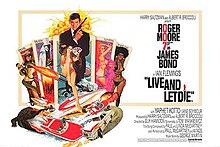 Theatrical release poster by Robert McGinnis | |
| Directed by | Guy Hamilton |
| Screenplay by | Tom Mankiewicz |
| Based on | Alive and Permit Die past Ian Fleming |
| Produced by | Harry Saltzman Albert R. Broccoli |
| Starring |
|
| Cinematography | Ted Moore |
| Edited by |
|
| Music past | George Martin |
| Production | Eon Productions |
| Distributed by | United Artists |
| Release dates |
|
| Running time | 121 minutes |
| Countries | Uk[1] United states of america[2] |
| Language | English |
| Upkeep | $7 meg |
| Box role | $161.8 1000000 |
Live and Allow Die is a 1973 spy picture. It was the eighth movie in the James Bond series produced past Eon Productions, and the kickoff to star Roger Moore as the fictional MI6 agent James Bail. It was directed by Guy Hamilton and produced past Albert R. Broccoli and Harry Saltzman, while Tom Mankiewicz wrote the script. Although the producers had approached Sean Connery to render later his role in the previous Bond flick Diamonds Are Forever, he declined, sparking a search for a new histrion to play Bond; Moore was signed for the atomic number 82 role.
The pic is based on Ian Fleming's 1954 novel of the aforementioned proper noun. The storyline involves a Harlem drug lord known every bit Mr. Big who plans to distribute two tons of heroin for costless to put rival drug barons out of business and then become a monopoly supplier. Mr. Large is revealed to be the alter ego of Dr. Kananga, a corrupt Caribbean dictator, who rules San Monique, a fictional island where opium poppies are secretly farmed. Bond is investigating the deaths of three British agents, leading him to Kananga, and he is soon trapped in a world of gangsters and voodoo as he fights to put a finish to the drug baron's scheme.
Live and Let Dice was released during the height of the blaxploitation era, and many blaxploitation archetypes and clichés are depicted in the film, including derogatory racial epithets ("honky"), black gangsters, and pimpmobiles.[three] It departs from the erstwhile plots of the James Bond films nearly megalomaniac super-villains, and instead focuses on drug trafficking, a mutual theme of blaxploitation films of the flow. Information technology is ready in African-American cultural centres such as Harlem and New Orleans, every bit well every bit the Caribbean area Islands. It was likewise the starting time James Bail film featuring an African-American Bond daughter romantically involved with 007, Rosie Carver, who was played past Gloria Hendry. The picture show was a box-office success and received generally positive reviews from critics. Its title song, written by Paul and Linda McCartney and performed by their ring Wings, was also nominated for the Academy Honor for Best Original Song.
Plot [edit]
Iii MI6 agents are killed under mysterious circumstances within 24 hours in the United nations headquarters in New York City, in New Orleans, and the small Caribbean nation of San Monique, while monitoring the operations of the island's dictator, Dr. Kananga. James Bail, Agent 007, is sent to New York to investigate. Kananga is also in New York, visiting the United nations. After Bond arrives, his driver is shot dead by Whisper, one of Kananga'due south men, while taking Bond to Felix Leiter of the CIA. Bail is near killed in the ensuing automobile crash.
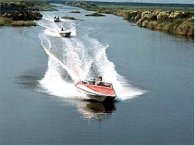
Glastron speedboats in the Louisiana boat chase. The boat chase scene was filmed in the Bayou Des Allemands.
The killer's licence plate leads Bond to Harlem where he meets Mr. Big, a mob dominate who runs a chain of restaurants throughout the United States, but he and the CIA practice not understand why the most powerful black gangster in New York works with an unimportant island's leader. Bond meets Solitaire, a beautiful tarot reader who has the ability of the Obeah and tin can see both the future and remote events in the nowadays. Mr. Large demands that his henchmen kill Bond, but Bond overpowers them and escapes with the help of CIA amanuensis Strutter. Bond flies to San Monique, where he meets Rosie Carver, a local CIA agent. They meet up with Bond's ally, Quarrel Jr., who takes them past boat nearly Solitaire'southward home. When Bond suspects Rosie of beingness a double agent for Kananga, Rosie tries to escape but is killed remotely by Kananga. Bail then uses a stacked deck of tarot cards that show but "The Lovers" to trick Solitaire into thinking that fate is meant for them; Bond then seduces her. Having lost her virginity and thus her ability to foretell the future, Solitaire realizes she would exist killed by Kananga, so she agrees to cooperate with Bail.
Bail and Solitaire escape by boat and fly to New Orleans. In that location, Bond is captured by Mr. Big, who removes his prosthetic face up and reveals himself to be Kananga. He has been producing heroin and is protecting the poppy fields by exploiting the San Monique locals' fear of voodoo priest Baron Samedi, as well as the occult. Every bit Mr. Big, Kananga plans to distribute the heroin gratuitous of accuse at his restaurants, which will increase the number of addicts. He intends to bankrupt other drug dealers with his giveaway, then accuse high prices for his heroin later in order to capitalise on the huge drug dependencies he has cultivated.
Angry at her for having sex activity with Bond and that her power to read tarot cards is now gone, Kananga turns Solitaire over to Businesswoman Samedi to exist sacrificed. Kananga's henchmen, one-armed Tee Hee and tweed-jacketed Adam, exit Bond to be eaten by crocodilians at his farm in the Deep South backwoods. Bond escapes by running along the animals' backs to safety. After setting the drug laboratory on fire, he steals a speedboat and escapes, pursued by Kananga's men under Adam's guild, every bit well as Sheriff J.Due west. Pepper and the Louisiana Land Police. Most pursuers get wrecked or left behind, and Adam does not survive Bond'southward strike.
Bond travels to San Monique and sets timed explosives throughout the poppy fields. He rescues Solitaire from the voodoo sacrifice and throws Samedi into a coffin of venomous snakes. Bail and Solitaire escape below ground into Kananga's lair. Kananga captures them both and proceeds to lower them into a shark tank. Notwithstanding, Bail escapes and forces Kananga to swallow a compressed-gas pellet used in shark guns, causing his trunk to inflate and explode.
Leiter puts Bond and Solitaire on a train leaving the country. Tee Hee sneaks aboard and attempts to impale Bond, but Bond cuts the wires of his prosthetic arm and throws him out the window. Every bit the film ends, a laughing Samedi is revealed to be perching at the front of the train.
Cast [edit]

Promotional epitome of the cast of Live and Let Die. From left: Julius Harris, Jane Seymour, Geoffrey Holder, Roger Moore, Yaphet Kotto and Earl Jolly Brownish
- Roger Moore every bit James Bail – 007, a British MI6 agent who is sent on a mission to investigate the murder of three fellow agents.
- Yaphet Kotto as Dr. Kananga / Mr. Big, a corrupt Caribbean area Prime number Minister who doubles as a drug lord.
- Jane Seymour as Solitaire, Kananga's psychic and Bond'due south dearest involvement.
- Clifton James as Sheriff J.West. Pepper, an uncouth Louisiana sheriff.
- Julius W. Harris as Tee Hee Johnson, Kananga'south master henchman who wears a pincer-tipped prosthetic arm.
- Geoffrey Holder as Baron Samedi, Kananga's henchman who has ties to the Voodoo occult.
- David Hedison as Felix Leiter, Bail'south CIA colleague who is too investigating Mr. Big.
- Gloria Hendry as Rosie Carver, a junior CIA agent in San Monique, secretly working for Kananga.
- Bernard Lee as M, the Head of the Hugger-mugger Intelligence Service
- Lois Maxwell as Miss Moneypenny, Thou'southward secretary.
- Tommy Lane as Adam, ane of Dr. Kananga'southward henchmen who pursues 007 through the Louisiana Bayou.
- Earl Jolly Brown as Whisper, Kananga's henchman who just whispers.
- Roy Stewart as Quarrel Jr., Bond'south ally in San Monique and son of Quarrel from Dr. No.
- Lon Satton equally Harry Strutter, a CIA amanuensis who assists Bail in New York.
- Arnold Williams as Cab Driver 1, a jokey New York taxi driver and one of Kananga's men.
- Ruth Kempf as Mrs. Bong, a student airplane pilot who gets defenseless up in Bond's escaping from Kananga'southward men.
- Joie Chitwood as Charlie, a CIA agent.
- Madeline Smith as Miss Caruso ("Beautiful Girl"), an Italian amanuensis whom Bond briefly romances at the commencement of the film.
- Michael Ebbin equally Dambala, one of Kananga's henchmen in San Monique and a voodoo priest who terrifies and kills his victims with a serpent.
- Kubi Chaza every bit Sales Girl, a cashier at the Oh Cult Voodoo Store in New York, and informant for Kananga.
- B. J. Arnau every bit a cabaret vocaliser, who performs a rendition of the movie'southward theme at a Fillet of Soul eating house.
Production [edit]
Writing [edit]
While filming Diamonds Are Forever, Live and Let Dice was chosen every bit the next Ian Fleming novel to exist adapted considering screenwriter Tom Mankiewicz idea it would be daring to employ black villains, as the Black Panthers and other racial movements were active at this time.[4]
Guy Hamilton was again chosen to direct and, since he was a jazz fan, Mankiewicz suggested he moving picture in New Orleans. Hamilton did not want to use Mardi Gras since Thunderball featured Junkanoo, a similar festivity, so later more discussions with the writer and location scouting with helicopters, he decided to use two well-known features of the city, the jazz funerals and the canals.[4] [5]
To develop a better feel of how Voodoo was practised, Saltzman and Broccoli escorted Hamilton, Mankiewicz, and product designer Syd Cain to lookout New Orleans further and then the islands of the West Indies. Haiti was an of import destination of the tour and not only did Fleming connect information technology with the faith,[7] there were many practitioners available to witness. Despite viewing actual demonstrations, due to political unrest in the country at the time it was decided not to film in Haiti.

"Trespassers Volition Be Eaten" – Gate to Jamaica Safari Hamlet at Ocho Rios, Jamaica, film location of the crocodile farm / drug lab (photo taken 1974)
While searching for locations in Jamaica, the crew discovered a crocodile subcontract owned by Ross Kananga, later on passing a sign warning that "trespassers will be eaten". The farm was put into the script and likewise inspired Mankiewicz to name the movie'due south villain after Kananga.[4]
Richard Maibaum later claimed he was asked to write the film, just declined, because he was too decorated. He disliked the terminal movie, saying, "to process drugs in the middle of the jungle is non a Bond caper."[8]
Casting [edit]
Broccoli and Saltzman tried to convince Sean Connery to return as James Bond, but he declined.[4] At the same time United Artists approached actors Adam West and Burt Reynolds. Reynolds told the studios that Bond should be played by a British actor and turned the offer down. Among the actors to test for the part of Bond were Julian Glover (who would portray Aristotle Kristatos in For Your Eyes Only), John Gavin, Jeremy Brett, Simon Oates, John Ronane, and William Gaunt. The chief frontrunner for the role was Michael Billington. Broccoli met with Anthony Hopkins about playing the role, but Hopkins did not think that he was right for the part.[ix] United Artists was all the same pushing to cast an American to play Bond, but producer Albert R. Broccoli insisted that the part should be played by a British actor and put frontwards Roger Moore. Moore, who had been considered by the producers earlier both Dr. No and On Her Majesty'southward Hush-hush Service, was ultimately chosen for the office.[5] After Moore was chosen, Billington remained on the top of the listing in the consequence that Moore declined to come up dorsum for the next film. Billington ultimately played a brief role in the pre-credit sequence of The Spy Who Loved Me (1977).
Moore tried non to imitate either Connery's or his own prior performance equally Simon Templar in The Saint, and Mankiewicz fitted the screenplay into Moore's persona by giving more comedic scenes and a light-hearted approach to Bail.[four]
Mankiewicz had idea of turning Solitaire into a Black woman, and Diana Ross was his beginning option.[3] [10] Broccoli and Saltzman decided to stick to Fleming's description of a white woman and, after considering Catherine Deneuve, cast Jane Seymour, who was in the TV series The Onedin Line.[4] After Solitaire was bandage with a white extra, the character of Rosie Carver was switched to exist a blackness woman and cast with Gloria Hendry. Yaphet Kotto was cast while doing another pic for United Artists, Across 110th Street.[four] Kotto reported one of the things he liked in the office was Kananga'south interest in the occult, "feeling like he can command past, present and time to come".[5]
Mankiewicz created Sheriff J.W. Pepper to add comic relief. Portrayed by Clifton James, Pepper appeared again in The Man with the Golden Gun.[iv] Live and Let Dice is besides the first of two films featuring David Hedison as Felix Leiter, who reprised the part in Licence to Kill. Hedison had said, "I was certain that would be my first and last" appearance equally the character, before being cast again.[eleven]
Madeline Smith, who played Miss Caruso, sharing Bond's bed in the film's opening, was recommended for the part past Roger Moore after he had appeared with her on boob tube. Smith said that Moore was polite and pleasant to work with, but she felt very uncomfortable being clad in only blue bikini panties while Moore'due south married woman was on prepare overseeing the scene.[12]
Alive and Let Dice was the only Bond film until Casino Royale (2006) not to feature "Q", played at this stage past Desmond Llewelyn. He was then appearing in the television serial Follyfoot, but was written out of three episodes to appear in the film.[thirteen] Past then, Saltzman and Broccoli decided not to include the character, feeling that "besides much was being fabricated of the films' gadgets", and decided to downplay this aspect of the serial,[14] much to Llewelyn'southward annoyance.[13]
Bernard Lee considered not reprising his role as Yard due to the death of his wife Gladys Merredew, and was nearly recast with Kenneth More. However, he ultimately returned to the role.
Lois Maxwell had only been included in Diamonds Are Forever during filming equally a late addition, as she had asked for a pay increase.[15] [sixteen] For Alive and Let Die, she returned for the same fee, but due to a technical error, the filming of her scenes in Bond'south home at the first of the movie extended to ii days, costing the production more than if they had paid the increment she requested. Moore later wrote that Maxwell celebrated the double-pay-day by purchasing a fur coat.[17]
Filming [edit]
Main photography began in October 1972 in the southern Usa, in Louisiana. For a while, only the second unit was shooting later Moore was diagnosed with kidney stones. Hamilton initially wanted to film in Republic of haiti, which the fictional San Monique was modeled afterwards, but could not considering of the political instability under the regime of François "Papa Md" Duvalier.[xviii] In November production moved to Jamaica, which represented San Monique. In December, production was divided betwixt interiors in Pinewood Studios in the UK and location shooting in Harlem in New York City.[iv] [19] [20] The producers were reportedly required to pay protection money to a local Harlem gang to ensure the crew'due south prophylactic. When the money ran out, they were forced to leave.[12] Some exteriors were in fact shot in Manhattan's Upper East Side as a result of the difficulties of using existent Harlem locations. The street chase was shot at FDR Drive.
Ross Kananga suggested the stunt of Bond jumping on crocodiles, and was enlisted past the producers to perform information technology.[3] The scene took 5 takes to exist completed, including one in which the concluding crocodile snapped at Kananga's heel, tearing his trousers.[4] The production also had trouble with snakes during the voodoo ceremony scene in Jamaica. The script supervisor was so afraid that she refused to be on prepare with them, an actor fainted while filming a scene where he is killed by a serpent, Jane Seymour became terrified as a snake was held up to her face, and Geoffrey Holder just agreed to fall into the snake-filled catafalque considering Princess Alexandra was visiting the set. Another notable incident was when during filming of this scene a dancer who held a snake was bitten, and he dropped the snake, and this grabbed everyone's attention. Meanwhile Seymour was tied up to a pale for this scene, and the loose snake then set up its sights on Seymour, who was saved by the film's ophidian handler, who grabbed it when it was mere inches from Seymour's feet.[four]
The boat chase was filmed in Louisiana effectually the Irish Bayou area, with some interruption caused by flooding.[5] 26 boats were built by the Glastron boat company for the motion picture. 17 were destroyed during rehearsals.[21] The speedboat jump scene over the bayou, filmed with the assistance of a specially-constructed ramp, unintentionally set a Guinness World Record at the time with 110 feet (34 m) cleared.[22] The waves created by the impact caused the following boat to flip over.[4] During the product the local sheriff tried to insist that no blackness men bulldoze vehicles in his parish, but he was forced to back down after the producers threatened to move the shoot to another location.[18]
The chase involving the double-decker bus was filmed with a former London motorbus adapted by having a top department removed, and then placed dorsum in situ running on brawl bearings to let information technology to slide off on affect. The stunts involving the bus were performed by Maurice Patchett, a London Transport motorcoach driving instructor.[3]
Salvador Dalí was approached in 1973 to design a Surrealist tarot deck for the film. Nevertheless his fee was besides much for the film budget.[23] At the end, the deck used in the film was designed by Fergus Hall.[24] Dalí kept working at the deck and released information technology in 1984.
Music [edit]

John Barry, who had worked on the previous seven films and orchestrated the "James Bond Theme", was unavailable during production. Broccoli and Saltzman instead asked Paul McCartney to write the theme vocal. Saltzman, mindful of his decision not to produce A Hard Day's Night, was especially eager to work with McCartney.[25] Since McCartney'due south salary was loftier and some other composer could not be hired with the rest of the music budget, George Martin, who had been McCartney's producer while with The Beatles, was chosen to write the score for the film.[26] "Live and Let Die", written past McCartney along with his wife Linda and performed by their group Wings, was the first true stone and roll vocal used to open a Bond motion picture, and became a major success in the United Kingdom (where it reached number nine in the charts) and the Us (where it reached number 2, for 3 weeks). It was nominated for an University Award, only lost to "The Fashion We Were". Producers hired B. J. Arnau to record and perform the championship song, not realising McCartney intended to perform it. Arnau'south version was featured in the film, when the singer performs it in a night club that Bond visits.[27]
The Olympia Brass Band has a notable part in "Alive and Let Die", in which they play a band leading a funeral march and one of Bond'south swain agents is assassinated while he is watching the march. Trumpeter Alvin Alcorn plays the killer. The slice of music the band plays at the start of the funeral march is "Just a Closer Walk with Thee". Afterward the agent is stabbed, the band starts playing the more than lively "Joe Avery's Piece", besides known equally "New 2d Line".
Release and reception [edit]
The film was released in the United states of america on 27 June 1973. The world premiere was at Odeon Leicester Square in London on 6 July 1973, with general release in the United Kingdom on the same mean solar day.[28] From a budget of around $seven one thousand thousand,[29] ($43 million in 2021 dollars[30]) the film grossed $161.8 million ($988 meg in 2021 dollars[30]) worldwide.[29]
The film holds the record for the almost viewed broadcast film on boob tube in the United Kingdom past alluring 23.5 meg viewers when premiered on ITV on twenty January 1980.[31]
Contemporary reviews [edit]
Roger Ebert of the Chicago Sun-Times stated that Moore "has the superficial attributes for the job: The urbanity, the quizzically raised eyebrow, the calm under fire and in bed". Nevertheless, he felt that Moore wasn't satisfactory in living upwards to the legacy left by Sean Connery in the preceding films. He rated the villains "a piddling banal", adding that the moving-picture show "doesn't have a Bail villain worthy of the Goldfingers, Dr. Nos and Oddjobs of the past."[32] Richard Schickel, reviewing for Fourth dimension, described the pic every bit "the most vulgar add-on to a series that has long since outlived its brief historical moment — if not, alas, its profitability." He also criticized the action sequences every bit excessive, but noted that "aside an allright speedboat spectacular over land and water, the motion picture is both perfunctory and anticipated—leaving the listen free to wander into the question of its overall taste. Or lack of it."[33] Roger Greenspun of The New York Times praised Moore every bit "a handsome, suave, somewhat phlegmatic James Bail—with a tendency to throw away his throwaway quips as the small-scale embarrassments that, alas, they commonly are." He was critical of Jane Seymour and Yaphet Kotto, the latter of whom he felt "does not project evil." In decision, he remarked the motion-picture show was "peculiarly well photographed and edited, and it makes clever and extensive apply of its good title song, by Paul and Linda McCartney."[34]
Charles Champlin of the Los Angeles Times likened Moore as "a handsome and smoothly likable successor to Sean Connery every bit James Bail." He further noted that the script "uses only the blank bones of Fleming's story about evil doings which link Harlem with a mysterious Caribbean island. The level of invention is high, simply now and again you lot do sense the strain of always having to try harder because yous're No. 1. If 1 menacing viper is good, three or a coffinful full are non inevitably better. But the action never slumps, and the series never seemed more similar a existent cartoon."[35] Diverseness wrote that Moore was "an okay replacement for Sean Connery. The Tom Mankiewicz script, faced with a real-world crisis in the villain sector, reveals that plot lines take descended further to the level of the old Saturday afternoon serial, and the treatment is more always similar a cartoon. Unchanged are the always-dubious moral values and the activity set up pieces. Guy Hamilton's direction is good."[36]
Retrospective reviews [edit]
Chris Nashawaty, reviewing for BBC, argues that Dr. Kananga/Mr. Big is the worst villain of the Roger Moore James Bond films.[37] Also from BBC, William Mager praised the apply of locations, but said that the plot was "convoluted". He stated that "Connery and Lazenby had an air of concealed thuggishness, clenched fists at the prepare, but in Moore's example a sardonic quip and a raised eyebrow are his deadliest weapons".[38] Danny Peary, in his book Guide for the Film Fanatic, noted that Jane Seymour portrays "one of the Bond series's well-nigh beautiful heroines", merely had little praise for Moore, whom he described as making "an unimpressive debut as James Bond in Tom Mankiewicz'south unimaginative accommodation of Ian Fleming's 2nd novel ... The movie stumbles along virtually of the way. Information technology's hard to remember Moore is playing Bond at times — in fact, if he and Seymour were black, the motion-picture show could pass every bit 1 of the blackness exploitation films of the solar day. In that location are few interesting action sequences — a motorboat chase is trite plenty to brainstorm with, just the filmmakers arrive worse by throwing in some stupid Louisiana cops, including pot-bellied Sheriff Pepper."[39]
Ian Nathan of Empire wrote "This is expert quality Bail, managing to reinterpret the classic moves — action, deduction, seduction — for a more modernistic idiom without breaking the mould. On one side nosotros get the employ of alligators every bit stepping stones and the pompous pitbull of rootin' tootin' Sheriff Pepper caught upwards in the thrilling gunkhole chase. On the other, the genuine aura of threat through weird voodoo henchman Tee Hee and the leaning toward — what's this? — realism in Mr Big's plot to take over the drug trade from the Mafia." He ended that "Moore had got his feet under the table."[40] IGN ranked Solitaire equally 10th in a Tiptop 10 Bond Babes listing.[41] In November 2006, Amusement Weekly listed Live and Let Die as the third-all-time Bond film.[42] MSN chose it every bit the thirteenth best Bond picture show[43] and IGN listed it as twelfth-all-time.[44] On the review aggregator website Rotten Tomatoes, the film has an blessing rating of 65% from 52 reviews based on 5.seven/10. The website'south critical consensus reads: "While not one of the highest-rated Bail films, Live and Let Die finds Roger Moore adding his stamp to the serial with flashes of manner and an improved sense of sense of humor."[45]
Accolades [edit]
In 2004, the American Film Plant nominated the song "Live and Let Die" from the film for AFI'south 100 Years...100 Songs.[46]
| Year | Award | Recipients | Consequence |
|---|---|---|---|
| 1974 | University Award for Best Original Song | Paul & Linda McCartney | Nominated |
| Grammy Award for Best Vocal Written for a Motility Picture | Nominated | ||
| Evening Standard Best Film | Guy Hamilton | Won |
See also [edit]
- List of American films of 1973
- List of drug films
- Outline of James Bond
References [edit]
- ^ "Dr. No". Lumiere. European Audiovisual Observatory. Retrieved 9 October 2020.
- ^ "AFI|Itemize – Alive and Permit Die". American Film Institute. Retrieved xxx December 2020.
- ^ a b c d Live and Let Dice Ultimate Edition DVD (Media notes). 2006.
- ^ a b c d e f g h i j k l Within Live and Permit Die: Live and Let Die Ultimate Edition, Disc two (DVD). MGM/UA Home Video. 2000. ASIN: B000LY209E.
- ^ a b c d Bond 1973: The Lost Documentary – Live and Let Dice Ultimate Edition, Disc two (DVD). MGM/UA Dwelling house Video. 1973. ASIN: B000LY209E.
- ^ Anderson, Jeffrey E., ed. (2015). The Voodoo Encyclopedia: Magic, Ritual, and Religion: Magic, Ritual, and Religion. p. 104. ISBN9781610692083 . Retrieved 11 May 2016.
- ^ Goldberg, Lee (1983). "Richard Maibaum 007'south Puppermaster". Starlog. p. 63.
- ^ "'Purple Rain' again and over again; and, Anthony Hopkins 007?". The Contained. 13 Dec 2012.
- ^ Mankiewicz, Tom; Crane, Robert (2012). My Life equally a Mankiewicz. University Press of Kentucky. p. 155.
- ^ David Hedison Interview Archived 10 Oct 2012 at the Wayback Car, Mi6-HQ.com
- ^ a b Roger Moore. Live and Permit Die Sound commentary ane. Alive and Permit Dice, Ultimate Edition, disk ane.
{{cite AV media}}: CS1 maint: location (link) - ^ a b "Llewelyn'due south last interview (with reference to Follyfoot and Live and Let Dice)". Follyfoot-goggle box.co.united kingdom of great britain and northern ireland. xix December 1999. Archived from the original on 17 Feb 2012. Retrieved 19 November 2010.
{{cite spider web}}: CS1 maint: unfit URL (link) - ^ "Memories of "Q"". Her Majesty'south Secret Servant. Archived from the original on 24 February 2014. Retrieved 24 February 2014.
- ^ Chapman, James (2008). Licence to Thrill: A Cultural History of the James Bond Films (Cinema and Society). I.B. Taurus Books. pp. 101–102. ISBN978-1845115159.
- ^ D'Abo, Maryam; Cork, John (2003). Bond Girls are Forever: The Women of James Bond. Harry Due north. Abrams Books. p. 87. ISBN978-0810943025.
- ^ Moore, Roger; Hedison, David (2018). The 007 Diaries: Filming Live and Let Dice. The History Press. ISBN978-0750987592.
- ^ a b Field, Matthew (2015). Some kind of hero : 007 : the remarkable story of the James Bail films. Ajay Chowdhury. Stroud, Gloucestershire. ISBN978-0-7509-6421-0. OCLC 930556527.
- ^ Exotic Locations. Live and Let Die, Ultimate Edition, disk 2.
{{cite AV media}}: CS1 maint: location (link) - ^ "Live and Let Die – Location Guide". Mi6-HQ.com. Archived from the original on 26 May 2012. Retrieved half dozen November 2008.
- ^ Sorensen, Eric (25 January 2007). "Big, gaudy and Bond-like, Seattle Boat Show exhibit cuts to the chase". The Seattle Times. Archived from the original on 24 May 2011.
- ^ Pearsall, Bill (28 January 1973). "Jumping Boats: James Bond Motion picture Goes to Any Length". The New York Times.
- ^ Kravinsky, Nina (7 November 2019). "Meet Surreal Tarot Cards Designed by Salvador Dalí for a James Bond Movie". Smithsonian Magazine . Retrieved xiv Baronial 2020.
- ^ "Lot 8 – Live and Let Die". Christie'south. 2012. Retrieved 14 August 2020.
A selection of ten prop tarot cards designed by Fergus Hall, used by Jane Seymour as Solitaire in Alive and Let Die – [...] The cards comprising 'The Fool', 'Expiry', 'Justice', 'Queen of Cups', 'High Priestess'(ii) and 'The Lovers' (4), the back of the cards with a red and white 007 design;
- ^ "James Paul McCartney". MI6 Confidential, Issue 5 (2018)
- ^ Lindner, Christoph (2003). The James Bond Phenomenon: a Critical Reader. Manchester Academy Printing. pp. 130–i. ISBN978-0-7190-6541-five.
- ^ The Music of James Bond. Jon Burlingame. Oxford University Press 2014. ISBN 978-0199358854
- ^ "Live And Let Die (1973)". Mi6-HQ.com. Archived from the original on 1 October 2012. Retrieved 29 June 2012.
- ^ a b "Live and Let Die". The Numbers. Nash Information Services, LLC. Archived from the original on 31 May 2012. Retrieved 31 October 2011.
- ^ a b 1634–1699: McCusker, J. J. (1997). How Much Is That in Existent Coin? A Historical Cost Index for Utilize as a Deflator of Money Values in the Economy of the U.s.a.: Addenda et Corrigenda (PDF). American Antique Club. 1700–1799: McCusker, J. J. (1992). How Much Is That in Real Money? A Historical Toll Index for Employ every bit a Deflator of Money Values in the Economy of the United States (PDF). American Antiquarian Society. 1800–present: Federal Reserve Bank of Minneapolis. "Consumer Price Alphabetize (judge) 1800–". Retrieved 16 April 2022.
- ^ "TV's jewels fail to smooth in list of all-time winners". Electronic Telegraph. seven Feb 1998. Archived from the original on 13 June 2013. Retrieved 13 October 2008.
- ^ Ebert, Roger (6 July 1973). "Alive and Permit Die". Chicago Sun-Times. Archived from the original on 27 October 2008. Retrieved 5 October 2008.
- ^ Schickel, Richard (nine July 1973). "Cinema: Dirty Play tricks". Time. Vol. 102, no. 2. Archived from the original on 14 Dec 2008. Retrieved 2 June 2020.
- ^ Greenspan, Roger (28 June 1973). "The Screen: 'Live and Let Dice' Opens". The New York Times. p. 56. Retrieved 2 June 2020.
- ^ Champlin, Charles (28 June 1973). "Moore Takes Over equally 007". Los Angeles Times. p. 17. Retrieved 2 June 2020 – via Newspapers.com.
- ^ Murphy, Arthur D. (27 June 1973). "Film Reviews: Alive and Let Die". Variety . Retrieved 2 June 2020.
- ^ Nashawaty, Chris (2 December 2008). "Moore ... And Sometimes Less: A look at the most — and to the lowest degree — memorable bad guys, babes, and Bonds in Roger Moore'southward 007 oeuvre". Entertainment Weekly. No. 1025. p. 37.
- ^ "Live and Let Die (1973)". BBC. Archived from the original on 22 June 2009. Retrieved v Oct 2008.
- ^ Peary, Danny (1986). Guide for the Pic Fanatic. New York: Simon & Schuster. p. 244. ISBN978-0-6716-ane-0814.
- ^ "Live and Let Dice at Empire online". Archived from the original on xi December 2015.
- ^ Zdyrko, Dave (15 November 2006). "Top 10 Bail Babes". IGN. Archived from the original on 25 July 2008.
- ^ Svetkey, Benjamin; Rich, Joshua (15 November 2006). "Ranking the Bond Films". Amusement Weekly. Archived from the original on xxx September 2008. Retrieved 20 September 2008.
- ^ Wilner, Norman. "Rating the Spy Game". MSN. Archived from the original on 19 January 2008. Retrieved 1 June 2009.
- ^ "James Bond'south Elevation 20". IGN. 17 November 2006. Archived from the original on half dozen November 2008. Retrieved 4 March 2008.
- ^ "Live and Allow Die (1973)". Rotten Tomatoes. Los Angeles, California: Fandango Media. Archived from the original on 12 June 2015. Retrieved 14 March 2008.
- ^ "AFI's 100 Years...100 Songs Nominees" (PDF). Archived (PDF) from the original on 17 April 2015. Retrieved xix August 2016.
External links [edit]
- Live and Let Die at IMDb
- Alive and Let Die at the TCM Picture show Database
- Live and Permit Die at AllMovie
- Live and Let Die at Rotten Tomatoes
- Live and Let Die at Box Function Mojo
- MGM Official Site: Live and Let Die
Source: https://en.wikipedia.org/wiki/Live_and_Let_Die_(film)
0 Response to "Will the Live Free or Die Special Be on Again"
Post a Comment