Chargebacks are an of import protection that increases public conviction in credit and debit bill of fare payments, especially in online transactions. However, they can also exist a huge headache for the merchants that take to deal with them. Many customers dispute transactions that don't autumn under the narrow list of bug chargebacks are intended to address or file a dispute without start contacting the merchant.
The overall number of chargebacks is increasing every year, and the coronavirus pandemic acquired a huge fasten in disputes in 2020 and 2021. Equally chargebacks take increased, more and more than businesses are taking action to prevent and fight them. What are chargebacks, and what do merchants need to know in order to preclude and fight them as effectively as possible?
If you lot take any questions about how to protect your business from chargebacks, please experience free to reach out to us direct.
Table of Contents
- What is a chargeback?
- How do chargebacks work?
- What is the chargeback procedure?
- What do chargebacks mean for merchants?
- How many chargebacks occur annually?
- How practice you lot file a chargeback?
- Why practise customers file chargebacks?
- When can a cardholder legitimately dispute a charge?
- What are chargeback reason codes?
- American Express Chargeback Reason Codes
- Visa Chargeback Reason Codes
- Mastercard Chargeback Reason Codes
- Discover Chargeback Reason Codes
- What are the three types of chargebacks?
- What is the EMV Liability Shift?
- Who is liable for chargebacks?
- Should merchants fight chargebacks?
- How do you write a chargeback rebuttal letter?
- Can you lot prevent all chargebacks?
- How much are chargeback fees?
- Know the facts about chargebacks
- What'southward the departure between a chargeback and a refund?
- How long practise you take to fight a chargeback?
- What is a chargeback threshold?
What is a chargeback?
A chargeback is a debit or credit card transaction that'south reversed by the cardholder's depository financial institution after they dispute a charge on their account. Chargebacks may too be referred to as payment disputes.
The meaning of the word chargeback is fairly straightforward. The depository financial institution will charge back the amount of the disputed transaction to the merchant, returning the money to the cardholder without needing the merchant's approval.
When a cardholder disputes a charge, banks typically review the transaction, and if the reason for the dispute is valid, provide a provisional credit to the customer's business relationship while the chargeback merits is resolved.
 Chargebacks for credit cards were first implemented in the 1974 Fair Credit Billing Act (§ 161. Correction of billing errors), an subpoena to the Truth in Lending Act.
Debit bill of fare chargebacks were implemented after by the Electronic Fund Transfer Act in 1978. These acts were intended to outline protective measures for consumers.
Chargebacks were a direct response to widespread corruption past fraudsters who could utilize and abuse stolen credit data without much the cardholder could practice about it.
Think almost it this way: A credit menu is lost or stolen and used to make fraudulent purchases. Before the Off-white Credit Billing Act, the cardholder would almost likely accept little or no recourse to get their money back one time the merchant had been paid.
The chargeback process allows consumers to go their refunds from their banks, and to allow banks (rather than cardholders and merchants) make decisions on how to handle the situation. While the procedure was not nevertheless called a chargeback, it would become the foundation for the dispute system we know today.
How do chargebacks piece of work?
Chargebacks are initiated by cardholders, evaluated by banks, and paid for by merchants. A unmarried chargeback, from initiation to resolution, can concluding months or even years.
While banks will sometimes file chargebacks for things like authorization or processing errors, nearly chargebacks occur when a cardholder contacts their bank to dispute a charge on their account. Usually, they do this because they don't recognize the accuse and believe information technology to exist fraudulent.
In some cases, however, a cardholder might dispute a charge because they experience they didn't become what they paid for and the merchant has refused to resolve the result.
Once a chargeback has been initiated, it will substantially go back and forth between the issuing banking company and the merchant until either one of them agrees to accept liability or until the card network must be chosen in to resolve the dispute.
What is the chargeback procedure?
The chargeback procedure begins with the merchant choosing to either take the chargeback or fight it through representment. In representment, the issuing bank reviews the merchant's evidence and either reverses or upholds the chargeback. In virtually cases, the chargeback ends here, just in that location are exceptions.

- When a cardholder disputes a transaction with their issuing bank, the banking company decides whether or not the customer has grounds to file a chargeback.
- If a chargeback is granted, the bank volition notify the acquiring banking concern—AKA the merchant'southward banking company—and debit the funds from the merchant's account.
- The merchant tin either have the chargeback or fight it by resubmitting the charge along with a rebuttal alphabetic character and the necessary show to disprove the merits. This process is called representment.
- The issuing depository financial institution volition review the new evidence and make a decision. If they find in favor of the merchant, the funds will be returned.
- At this point, any party unhappy with the decision tin contest the issue further by initiating pre-arbitration. This near ofttimes occurs when the issuing bank decides in the merchant's favor, but then receives new show that puts that decision in question.
- If neither political party accepts liability during pre-arbitration, the chargeback moves to arbitration. Hither, the bill of fare network will examine the evidence and make a terminal decision. This conclusion tin can't be appealed farther, and the losing party will exist required to pay hundreds of dollars in fees.
Time limits for merchants to reply to a dispute vary based on the credit card network and the reason code. Annotation that the timer begins when the chargeback is initiated, not when the merchant is notified, and then the merchant'south borderline may not exist the exact time frame outlined by the carte du jour network'south policies.
What do chargebacks mean for merchants?
For merchants, chargebacks hateful a loss of acquirement ofttimes every bit much as twice the transaction amount when fees and other costs are factored in. They too crusade the merchant'southward chargeback ratio to increase, which can lead to serious consequences.
If a merchant's chargeback ratio exceeds certain thresholds established by the carte networks and other financial institutions they exercise concern with, they may face up fines, additional chargeback fees, and fifty-fifty termination of their merchant account. The well-nigh mutual threshold is i%, but Visa recently lowered theirs to 0.9%.
How many chargebacks occur annually?
Information well-nigh chargebacks is by and large only shared with the parties involved, and the card networks don't seem interested in sharing whatever information they have. That makes specific information about how many chargebacks occur difficult to come by.
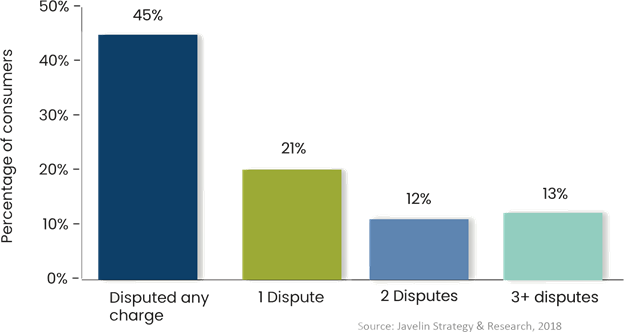
We do accept some data from a 2018 survey by Javelin Research showing that nearly half of all customers have disputed a charge, and a majority of those take disputed more i.
We also know that chargebacks go on to grow twelvemonth after year. A 2018 report by Aite Group predicted that the full value of chargebacks would climb to $35 billion by 2021, and given the increment in disputes that accompanied the COVID-19 pandemic, information technology wouldn't be surprising to discover we've already far exceeded that number.
How do you file a chargeback?
Filing a chargeback without first consulting the merchant is non advised and, in some cases, unlawful. If y'all've already attempted to reconcile the issue with the merchant with no success, just call your bank and asking to dispute the transaction.
The banking concern will typically give yous a provisional credit for the amount of the charge while they investigate the validity of the merits. Be prepared to describe the problems you've had with the merchant and the steps you've taken to resolve the matter.
Why do customers file chargebacks?
Customers frequently file chargebacks when they don't recognize a transaction or are somehow dissatisfied with their buy. As friendly fraud becomes more prevalent, it's important to note that in some cases the customer may simply be trying to go something for free.
In order to place the reason a client disputed a accuse, it tin be helpful to examine the reason lawmaking on the chargeback.
Every chargeback has a reason code associated with it. The major carte networks (Visa, Mastercard, Observe, and American Express) established these codes to clearly place the reason a chargeback was requested.
What are chargeback reason codes?
Chargeback reason codes tell merchants the reason the client is disputing a charge, according to the information they provided to their bank. Each reason code has certain standards of proof and evidence associated with it that determine whether the chargeback is valid or not.
While the reason code volition tell you the reason that the cardholder gave to the bank for why they wanted to dispute the accuse, it's important to proceed in mind that this isn't e'er the real reason for the chargeback.
Some customers may incorrectly retrieve that a charge on their account was unauthorized considering they don't recognize the name of the business listed in their account. Others may have forgotten a recurring accuse they agreed to.
There are also some customers who want to file a chargeback because of a negative experience they had with the merchant, but know that the reason they have isn't legitimate. In order to go the chargeback, they lie to the banking company most their reason for requesting one. In some cases, a customer may have made a purchase with the intention of fraudulently disputing the accuse afterwards in an effort to get their money dorsum.
When can a cardholder legitimately dispute a charge?
Chargebacks are non something that cardholders can merely use whenever they don't similar an item they purchased. At that place is ordinarily but 1 situation where a cardholder should reach out to a bank first for chargebacks: true fraud.
If a cardholder is a victim of true fraud (card theft, identity theft, etc.) then a chargeback is not only legitimate, but is the upstanding solution for the issuing bank and the merchant to resolve the issue.
 Customers can also file chargebacks when they didn't receive the product or service they paid for, whether because of a lost or damaged shipment or an incorrect item being sent. Existence double-charged or overcharged the agreed purchase corporeality is another legitimate reason for a dispute.
However, issues like these are usually resolved more quickly and easily when the customer contacts the merchant, and a chargeback should only exist used when the merchant is uncooperative.
There are multiple meanings to the give-and-take "chargeback", based on the cardholder's actions. The primary legitimate use of the word is for truthful fraud chargebacks, but some customers commit "friendly fraud" by filing a chargeback without a legitimate reason.
Customers can't dispute a charge just because they are dissatisfied with the product or service they received. These issues must always be resolved with the merchant directly.
American Express Chargeback Reason Codes
Acquire how to fight each of these American Express Chargeback Codes >>>
| Chargeback Lawmaking | Description |
| Authorisation | |
| A01 | Charge Amount Exceeds Authorization Amount |
| A02 | No Valid Say-so |
| A08 | Authorisation Approval Expired |
| Fraud | |
| F10 | Missing Imprint |
| F14 | Missing Signature |
| F24 | No Menu Member Authorization |
| F29 | Menu Non Present |
| F30 | EMV Apocryphal |
| F31 | EMV Lost/Stolen/Non-Received |
| Card Member Dispute | |
| C02 | Credit Not Processed |
| C04 | Goods/Services Returned or Refused |
| C05 | Goods/Services Cancelled |
| C08 | Goods/Services Not Received |
| C14 | Paid by Other Means |
| C18 | "No Testify" or CARDeposit Cancelled |
| C28 | Cancelled Recurring Billing |
| C31 | Goods/Services Not as Described |
| C32 | Goods/Services Damaged or Defective |
| Processing Error | |
| P01 | Unassigned Card Number |
| P03 | Credit Candy as Charge |
| P04 | Charge Processed as Credit |
| P05 | Incorrect Charge Amount |
| P07 | Late Submission |
| P08 | Indistinguishable Accuse |
| P22 | Non-Matching Card Number |
| P23 | Currency Discrepancy |
| Enquiry/Miscellaneous | |
| R03 | Insufficient Answer |
| R13 | No Answer |
| M01 | Chargeback Authorization |
| M10 | Vehicle Rental - Capital Amercement |
| M49 | Vehicle Rental - Theft or Loss of Employ |
| FR2 | Fraud Full Recourse Programme |
| FR4 | Immediate Chargeback Program |
| FR6 | Partial Immediate Chargeback Programme |
Visa Chargeback Reason Codes
Learn how to fight each of these Visa Chargeback Codes >>>
| Chargeback Code | Description |
| Fraud | |
| 10.1 | EMV Liability Shift Counterfeit Fraud |
| 10.2 | EMV Liability Shift Not-Counterfeit Fraud |
| ten.3 | Other Fraud — Card Nowadays Surroundings |
| 10.4 | Other Fraud — Card Absent-minded Surround |
| 10.5 | Visa Fraud Monitoring Plan |
| Authorization | |
| xi.1 | Card Recovery Bulletin |
| 11.2 | Declined Authorization |
| 11.3 | No Say-so |
| Processing Errors | |
| 12.one | Late Presentment |
| 12.2 | Wrong Transaction Code |
| 12.3 | Incorrect Currency |
| 12.4 | Wrong Account Number |
| 12.v | Wrong Amount |
| 12.6.1 | Duplicate Processing |
| 12.6.ii | Paid past Other Means |
| 12.7 | Invalid Data |
| Consumer Disputes | |
| 13.1 | Trade/Services Non Received |
| 13.2 | Cancelled Recurring |
| 13.3 | Not as Described or Lacking Merchandise/Services |
| 13.4 | Counterfeit Merchandise |
| 13.5 | Misrepresentation |
| 13.half-dozen | Credit Not Candy |
| thirteen.7 | Cancelled Merchandise/Services |
| 13.eight | Original Credit Transaction Non Accepted |
| 13.9 | Non-Receipt of Cash or Load Transaction Value |
Mastercard Chargeback Reason Codes
Learn how to fight each of these Mastercard Chargeback Codes >>>
| Lawmaking | Clarification |
| Say-so | |
| 4808 | Required Authorization Not Obtained |
| 4808 | Expired Chargeback Protection Period |
| 4808 | Multiple Authorization Requests |
| 4808 | Cardholder-Activated Last (True cat) 3 Device |
| Indicate of Interaction Error | |
| 4834 | Transaction Amount Differs |
| 4834 | Belatedly Presentment |
| 4834 | Point-of-Interaction Currency Conversion |
| 4834 | Cardholder Debited More than Once for the Same Goods or Services |
| 4834 | ATM Disputes |
| 4834 | Loss, Theft, or Damages |
| Fraud | |
| 4837 | No Cardholder Potency |
| 4849 | Questionable Merchant Activity |
| 4870 | EMV Chip Liability Shift |
| 4871 | EMV Chip/PIN Liability Shift |
| Cardholder Disputes | |
| 4853 | Cardholder Dispute of a Recurring Transaction |
| 4853 | Issuer Dispute of a Recurring Transaction |
| 4853 | Goods or Services Not Provided |
| 4853 | No-Testify Hotel Charge |
| 4853 | Addendum Dispute |
| 4853 | Credit Non Processed |
| 4853 | Appurtenances/Services not as Described or Defective |
| 4853 | Digital Goods $25 or less |
| 4853 | Apocryphal Appurtenances |
| 4853 | Transaction Did Not Consummate |
| 4853 | Credit Posted as a Buy |
| 4853 | Timeshares |
| 4854 | Cardholder Dispute Not Classified Elsewhere |
| Other | |
| 4850 | Installment Billing Dispute (Participating Countries Merely) |
| 4999 | Domestic Chargeback Dispute (Europe Region But) |
Notice Chargeback Reason Codes
Learn how to fight each of these Discover Chargeback Codes >>>
| Chargeback Code | Description |
| Fraud | |
| UA01 | Fraud – Menu Nowadays Transaction |
| UA02 | Fraud – Card Not Present Transaction |
| UA05 | Fraud – Chip Counterfeit Transaction |
| UA06 | Fraud – Flake and PIN Transaction |
| UA10 | Request Transaction Receipt (swiped carte du jour transactions) |
| UA11 | Cardholder Claims Fraud (swiped transaction, no signature) |
| Say-so | |
| NA | No Authorization |
| DA | Declined Say-so |
| AT | Authorization Not-Compliance |
| EX | Expired Bill of fare |
| Processing Errors | |
| IN | Invalid Carte Number |
| LP | Tardily Presentation |
| Services | |
| 5 | Good Faith Investigation |
| AA | Does Not Recognize |
| AP | Recurring Payments |
| AW | Altered Amount |
| CD | Credit/Debit Posted Incorrectly |
| DP | Duplicate Processing |
| IC | Illegible Sales Data |
| NF | Non-Receipt of Cash from ATM |
| PM | Paid by Other Means |
| RG | Non-Receipt of Goods, Services, or Cash |
| RM | Cardholder Disputes Quality of Goods or Services |
| RN2 | Credit Non Processed |
| Other | |
| DC | Dispute Compliance |
| NC | Non Classified |
What are the three types of chargebacks?
The 3 types of chargebacks are true fraud, friendly fraud, and merchant error. Each blazon results from unlike circumstances and should be handled in a different way. Friendly fraud is by far the virtually common type of chargeback, making up threescore%-80% of all chargebacks.

True fraud
True fraud chargebacks are what chargebacks were invented for: unauthorized charges against a credit card past a scammer or identity thief. Merchants are strongly brash not to waste fourth dimension or resource attempting to dispute these chargebacks.
True fraud chargebacks are all-time prevented through fraud prevention tools. AVS and CVV matching are the blank minimum, but many merchants also employ 3-D Secure ii.0 or 3rd-party tools that use machine learning to try to weed out fraudulent transactions.
Friendly fraud
Friendly fraud chargebacks are when customers written report valid charges as fraudulent to get the charge reversed. They might do this deliberately, with malicious or criminal intent, or they might do it out of impatience or confusion. Friendly fraud chargebacks often masquerade as true fraud chargebacks, with the customer falsely challenge they never authorized the charge.
These chargebacks are difficult to forbid, but can be fought through representment to recover lost revenue. Customers who file friendly fraud chargebacks can also be blacklisted.
Merchant error
Merchant error chargebacks occur when the crusade of the chargeback is an error made by the merchant, such equally shipping the wrong item. Disputes like this tin sometimes exist fought effectively, simply the flaws in merchant operations these chargebacks reveal must be remedied to forbid similar future chargebacks.
Merchant error chargebacks tin be prevented by improving business operations, past having hands available and helpful client service, and by having a generous refund policy.
What is the EMV Liability Shift?
October 1st, 2015, the EMV Liability Shift went into outcome. This means that merchants using the magnetic stripe on a card that has an EMV chip will exist automatically held liable for whatsoever fraud or chargeback associated with that transaction.
The basic idea is that if an EMV carte du jour is used fraudulently and the merchant had not upgraded their processing equipment to EMV-compliant standards, the blame for that fraudulent transaction lies with the merchant.
The EMV Liability Shift caused almost merchants to upgrade to EMV payment engineering science, which is much less vulnerable to fraud than traditional magnetic strips. Even so, it may also have resulted in an increase in fraudulent chargebacks. Savvy fraudsters have learned that if they convince a merchant to swipe a carte with an EMV chip and after dispute that charge, the merchant will lose the dispute.
Who is liable for chargebacks?
Merchants are liable for chargebacks in most cases and acquit the burden of proof in any dispute. A merchant must brand their case for why a chargeback should exist reversed. If no action is taken by the merchant, the cardholder wins by default.
For card-present merchants, if the purchase is made using an EMV chip and the transaction turns out to be fraudulent, the issuing bank is held liable instead of the merchant. The merchant is however responsible for chargebacks arising due to merchant errors.
Should merchants fight chargebacks?
In the event a chargeback seems illegitimate, it's important merchants fight back through representment whenever possible. Though a client might claim a transaction was fraudulent, merchants very frequently accept the prove they need to evidence otherwise, which could allow them to recover their losses.
Merchants who receive a chargeback that they believe is unfounded take the right to contest the example. To do so, they'll first need to submit a rebuttal letter to debate their case, along with a number of supporting documents and pieces of evidence. Exactly what bear witness they'll need volition depend on the exact reason lawmaking associated with the chargeback.
When a merchant contests a cardholder chargeback, it then enters representment. During this process, the merchant provides information regarding the transaction and why they believe that transaction was legitimate.
The merchant works with their sales  section and/or their chargeback management company to build a dispute package that outlines the show and attempts to convince the issuing bank according to that bank's guidelines.
Post-obit this, the acquiring bank sends the information back through the credit carte network to the issuing banking concern, who makes their decision and informs the involved parties.
If yous plan to dispute a chargeback, it's important to act rapidly. Issuers often lag behind when notifying acquirers and merchants of chargebacks, so you may accept a very small window in which to respond. Having a chargeback representment team at your disposal tin help you act swiftly and efficiently, no matter what the deadline may be.
How do you write a chargeback rebuttal alphabetic character?
Depending on the credit or payment provider, you can either write a letter or submit a form containing your dispute information package. A rebuttal letter outlines your case and addresses the cardholder's complaint.
A prompt rebuttal letter can help you meliorate accost fraudulent chargebacks and win disputes. When done right, a rebuttal letter provides a simple overview of why the customer's claims are false and what bear witness you have to evidence information technology. When disputing friendly fraud chargebacks, a proficient rebuttal letter combined with sufficient evidence will typically convince the issuing bank to rule in your favor and return your acquirement.
Tin can you foreclose all chargebacks?
Non every dispute can be prevented. Some are the result of genuine criminal activity, and some come about because of mistakes or oversights on the merchant's behalf. When advisable measures are taken, merchants can reduce their chargebacks past about 70%.
Studying and fighting disputes volition help you acquire why they're happening to you, and addressing those root causes is by far the all-time thing you lot can do to forbid time to come chargebacks.
How much are chargeback fees?
Chargeback fees typically range from $20-$100 depending on your acquiring depository financial institution. Yet, the true cost of a chargeback is often up to ii.five times the transaction value. So, for a $100 chargeback, a merchant would pay $250 in fees, fines, client acquisition costs, and more.
| Expense | Physical Goods | |
| Transaction Cost | $250 | $250 |
| Processing Fee | $x | $ten |
| Chargeback Fee | $25 | $25 |
| Product/Service Cost | $75 | $l |
| Marketing Cost | $100 | $100 |
| Fraud Direction Toll | $5 | $five |
| Fulfillment Toll | $five | $3 |
| Customer Service Toll | $2 | $2 |
| Operations Price | $50 | $35 |
| Total Revenue Loss | $522 | $480 |
| Truthful Price | 2.1x | one.92x |
Chargebacks can threaten your cash flow and put your merchant accounts at hazard, likewise. They can increase your merchant account costs or cause your accounts to be shut down, preventing yous from accepting payments birthday.
Know the facts virtually chargebacks
When you understand what chargebacks are, you can fight them more than effectively, learn from them, and take steps to prevent them. Even when choosing a chargeback management firm to deal with them for you, having a solid grounding in the facts about chargebacks will aid you know whether that business firm is providing you lot with a skilful render on your investment.
Regardless of your level of experience with chargebacks, Chargeback Gurus tin guide you to the best possible outcomes for your company. Download your copy of the Chargebacks 101 Guide to better help you empathize the causes of chargebacks, and how the overall chargeback procedure works so you can fight client chargebacks and foreclose them in the starting time identify.
FAQ
What'southward the divergence between a chargeback and a refund?
In a chargeback, the cardholder contacts their issuing bank to force a reversal of a transaction. In a refund, the customer contacts the merchant starting time, and the merchant can initiate a return payment, avoiding the fees and other consequences associated with chargebacks.
How long do y'all have to fight a chargeback?
Depending on the menu network, merchants have between 7 and xxx days to respond to a chargeback. If the merchant takes no action past the deadline, they volition lose by default, and may be assessed an additional fee for not responding.
What is a chargeback threshold?
A chargeback threshold is typically calculated as a ratio of chargebacks to total transactions, with i% being the near common limit. Merchants exceeding their chargeback threshold may face penalties upward to and including have their accounts terminated.
Thanks for following the Chargeback Gurus blog. Feel free to submit topic suggestions, questions or requests for advice to: win@chargebackgurus.com
0 Response to "How to Know if You Are Charged or if It Is an Impeding Charge in Credit Card"
Post a Comment