How Do You Know if Your Coin Is Denver Mint
| Denver Mint | |
| U.S. National Register of Celebrated Places | |
| Colorado State Annals of Historic Properties | |
 The Denver Mint | |
| Location | Westward Colfax Avenue and Delaware Street, Denver, Colorado |
|---|---|
| Coordinates | 39°44′23″N 104°59′xxx.17″W / 39.73972°Due north 104.9917139°West / 39.73972; -104.9917139 Coordinates: 39°44′23″Northward 104°59′30.17″W / 39.73972°N 104.9917139°Westward / 39.73972; -104.9917139 |
| Congenital | 1897 |
| Architect | James Knox Taylor |
| Architectural style | Late 19th and 20th century revivals |
| NRHP referenceNo. | 72000270[1] |
| CSRHPNo. | 5DV.164 |
| Added to NRHP | February 1, 1972 |
The Denver Mint is a branch of the United States Mint that struck its first coins on February 1, 1906.[2] The mint is however operating and producing coins for circulation, likewise as mint sets and commemorative coins. Coins produced at the Denver Mint carry a D mint marking (not to be confused with the mark of the Dahlonega Mint). The Denver Mint is the single largest producer of coins in the earth.[3]
History [edit]
Clark, Gruber & Co. [edit]
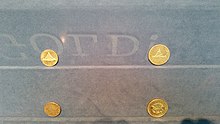
The predecessors of the Denver Mint were the men of Clark, Gruber and Company. During the Pikes Peak Gilt Rush, they coined gold dust brought from the gold fields past the miners. In 1858, Austin M. Clark, Milton E. Clark and Emanuel Henry Gruber founded a brokerage firm in Leavenworth, Kansas, and and so established an role in Denver at the beginning of the Colorado Gold Rush. Desiring to salve on aircraft and insurance costs associated with shipping gold back east, the firm opened a private mint. On 25 July 1860, the mint opened in a two-story brick edifice on the corner of Market place and 16th Streets, minting $10 gold pieces at the rate of "fifteen or 20 coins a minute". "On the face up is a representation of the peak, its base surrounded by a forest of timber and 'Pikes Peak Aureate' encircling the summit. Immediately under its base of operations is the give-and-take 'Denver', and below it 'X D.'. On the opposite is the American Eagle encircled by the proper name of the firm 'Clark, Gruber & Co.', and below the date, '1860'."[iv] : 26–27
A $xx gilded coin was added, "the weight will be greater, just the value the same equally the United States money of like denomination". A $5 and a $ii.v gold coin were added, with production reaching $18,000 per calendar week. On the front end was the "head of the Goddess of Liberty surrounded past thirteen stars, with "Clark & Company" in the tiara. "Pikes'southward Peak Gold, Denver" was on the other side, with "5D." or "2 1/ii D."[4] : 27
In the nearly three years of performance, they minted $594,305 worth of Pike'south Superlative gilt in the form of gold coins. Additionally, they purchased 77,000 troy ounces of raw golden, and shipped "big amounts of dust" to the Philadelphia Mint. The building, assaying and minting equipment was formally bought by the United states Treasury in April 1863. Clark, Gruber & Co. remained a banking concern until bought past the First National Depository financial institution of Denver in 1865.[iv] : 27
Act of Congress 1862 [edit]
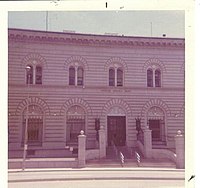
The Denver Mint in a May 1972 photograph
Established by an Act of Congress on April 21, 1862, the U.s.a. Mint at Denver opened for business organisation in tardily 1863 as a U.s.a. Assay Office. Operations began in the facilities of Clark, Gruber and Company, located at 16th and Market Streets and acquired past the government for $25,000, which it was but able to print off at the location.
Unlike Clark, Gruber and Company, though, the Denver plant performed no coinage of gold as starting time intended.[4] : 77 One reason given by the Director of the Mint for the lack of coinage at Denver was, "…the hostility of the Indian tribes forth the routes, doubtless instigated by rebel emissaries (there being a Ceremonious War) and bad white men."
Gold and nuggets brought there by miners from the surrounding area were accepted by the Analysis Office for melting, assaying, and stamping of cast aureate bars. The bars were so returned to the depositors as imparted bars stamped with the weight and fineness of the gold. Most of the golden came from the rich beds of placer gilded found in the streams and first discovered in 1858, the same year Denver was founded.
When the supply of gold was wearied from the streams, the emphasis turned to lode mining, uncovering veins of ore with a loftier percentage of gold and argent. By 1859, the yearly value of the gilt and argent deposited at the Assay Role was over $v.half dozen 1000000. During its early years equally an Assay Function, the Denver plant was the city's well-nigh substantial structure.
The United States Treasury did not aggrandize its smelting and refining operations at the same rate as the discovery and production of gold. In 1872 a grouping of businessmen led by Judge Hiram Bond (formerly one of the largest brokers on the New York Gold Exchange), Joseph Miner and Denver Mayor Joseph Eastward. Bates prepare up a business firm Denver Smelting and Refining Works which built an contained complementary plant which processed ore into ingots which were then assayed, weighed and stamped by the Denver Mint.
There was new hope for branch mint status when Congress provided for the establishment of a mint at Denver for golden and silver coin production. The site for the new mint at Due west Colfax and Delaware streets was purchased on Apr 22, 1896, for approximately $60,000. Construction began in 1897.
Appropriations to consummate and equip the constitute were bereft, and the transfer of assay operations to the new building were delayed until September 1, 1904. Coinage operations finally began on February ane, 1906, advancing the status of the Denver facility to Branch Mint. In improver, before the new mechanism to be used at the Mint was installed for apply, it was first sent to the St. Louis Exposition of 1904 for brandish. Silver coins were minted in Denver for the first time in 1906. During the first year, 167 million coins were produced, including $20 gold (double eagle) coins, $10 gilded (eagle) coins, $five gold (half eagle) coins, and assorted denominations of silver coins.
The mint in popular culture [edit]
- The Denver Mint is featured in the 1993 Sylvester Stallone motion picture Bewilderment, as the production point of the money stolen in the film, and the divergence point for the airplane.
- The Denver Mint appears anachronistically in the 1870s in the 1967 The Wild Wild West episode "The Nighttime of the Circus of Death".
- Similarly to above, The Mint is as well anachronistically set in the 1870s in the 1960 Shotgun Slade episode "The Missing Train".
- The Denver Mint is referenced in the title of a Jimmy Eat World rail from the anthology Clarity called Lucky Denver Mint.
Run across also [edit]
- Gold mining in Colorado
- List of Mints
- Historical U.s. mints
- Silver mining in Colorado
References [edit]
- ^ "National Annals Data System". National Register of Historic Places. National Park Service. March xv, 2006.
- ^ "United States Mint at Denver Celebrates 100 Years of Modify". The U.s.a. Mint. Retrieved Jun 20, 2009.
- ^ "Denver US Coin Mint". usacoinbook.com. United states of america Coin Book. Retrieved 9 Nov 2019.
- ^ a b c d Voynick, S. M. (1992). Colorado Gold: From the Pike's Pinnacle Rush to the Present. Missoula, Mont.: Mountain Printing Publishing Company. ISBN0878424555. OCLC 314614194.
- "History of the Denver Mint". Fact Sheets: Currency & Coins. U.S. Treasury Department. Archived from the original on January 3, 2007. Retrieved March 17, 2017.
External links [edit]
- The U.S. Mint
- Visitors' data at the Denver Mint
Source: https://en.wikipedia.org/wiki/Denver_Mint
0 Response to "How Do You Know if Your Coin Is Denver Mint"
Post a Comment